
5 Mistakes Homeowners Make When Choosing Outdoor Shades for Their Patio
Picking outdoor shades sounds simple until you’ve already spent the money and realize the shades fade after one summer, flap around in the wind, or don’t actually block the sun at the angle you needed. These are not rare experiences. They happen because most homeowners shop for outdoor patio shades the same way they shop for curtains, without accounting for the specific demands of an outdoor environment.
This guide breaks down the five most common mistakes people make when choosing outdoor shades, so you can avoid them before you commit to anything.
Mistake 1: Choosing Style Over Sun Angle
Most people walk into the buying process thinking about how the shades will look. That’s understandable. Aesthetics matter. But the number one job of any outdoor shade is to block the sun, and if it can’t do that effectively for your specific patio, it doesn’t matter how good it looks.
The sun moves throughout the day, and depending on which direction your patio faces, your shade problem is different from your neighbor’s. A west-facing patio gets hammered with intense late afternoon sun. An east-facing one deals with harsh morning glare. South-facing patios get sun for most of the day.
Before you choose anything, spend a few days paying attention to when and where the sun hits your patio the hardest. Then think about the type of outdoor shade that actually addresses that specific problem. A retractable awning works great for overhead coverage. Exterior sun shades or roller shades work better for blocking horizontal glare coming from the side. Motorized screens can handle both.
If you skip this step, you could end up with beautiful outdoor shades that do absolutely nothing for the part of your patio where you actually sit.
What the sun angle determines:
The direction your patio faces should drive the type of shade you buy. Overhead shades handle high, midday sun. Vertical or angled shades handle low morning and afternoon sun. In most cases, a combination works better than a single solution, and that’s worth knowing before you buy.

Mistake 2: Ignoring the Wind
Outdoor shades that are not rated for wind are one of the most expensive mistakes you can make. Not because the shades themselves cost a fortune, but because of what happens when they fail. Fabric tears. Frames bend. Cheap retractable mechanisms break. And if the shade comes loose in a serious storm, it can damage your home or injure someone.
Wind is not a secondary consideration for outdoor patio shades. It’s a primary one, especially if you live somewhere with unpredictable weather.
When evaluating any outdoor shade product, ask specifically about wind resistance ratings. Quality retractable awnings come with wind sensors that automatically retract the awning when wind speeds exceed a safe threshold. Motorized screens are typically built with tensioned systems that hold up significantly better in wind than freestanding fabric panels.
What you want to avoid are outdoor shades marketed purely on looks and price with no mention of structural performance. A shade that fails in the first serious storm is not a shade. It’s an expensive mistake.
What to ask before buying:
Ask the manufacturer or installer what wind speed the product is rated for. Ask whether motorized models include automatic wind sensors. Ask about the frame material, aluminum holds up better than lower-grade materials in outdoor conditions. If you get vague answers, walk away.
Mistake 3: Buying for Price Instead of Total Cost
This is the mistake that costs homeowners the most money over time, and it’s also the most predictable one. Budget outdoor shades are everywhere. They’re on Amazon, in big box stores, and on discount home improvement sites. They look fine in photos. The price seems reasonable.
Then they fade within a season. The fabric frays at the edges. The mechanism sticks or breaks. And two years later, you’re buying again.
When you factor in the cost of replacing cheap patio shades every two to three years, plus the time spent reinstalling them, the “affordable” option often ends up costing more than a quality product installed correctly the first time.
This doesn’t mean you need to buy the most expensive outdoor shades on the market. It means you should think in terms of lifespan. A well-built retractable awning with a quality fabric and a solid aluminum frame, installed by someone who knows what they’re doing, can last 15 to 20 years with basic maintenance. A cheap fabric shade from a big box store might last two.
What durability actually looks like:
Look for solution-dyed acrylic fabrics, which hold color significantly longer than coated polyester. Look for powder-coated aluminum frames rather than painted steel. Look for manufacturers that offer meaningful warranties, not 90-day coverage that conveniently expires before the problems show up.
Mistake 4: Underestimating the Value of Professional Installation
A lot of homeowners buy outdoor shades with the intention of installing them themselves to save money. For very simple shade sails or small window sun shades, that might work fine. But for retractable awnings, motorized screens, and larger exterior shade systems, DIY installation is one of the most common reasons things go wrong.
The most frequent issues from improper installation include:
Shades that are mounted at the wrong angle and don’t actually provide the coverage the homeowner expected. Awnings anchored into insufficient wall structures that pull away from the house under load. Motorized systems wired incorrectly that either don’t work or create electrical issues. Fabric that’s tensioned unevenly and starts sagging or tearing prematurely.
None of these are small problems, and most of them void manufacturer warranties. If you’re investing in quality outdoor shades for your patio, the installation is not the place to cut corners.
A professional installer will assess your wall structure, determine the correct mounting approach, set the pitch correctly for water runoff, and make sure motorized systems are wired and calibrated to function as intended. That work has real value. The cost of fixing a bad DIY installation almost always exceeds what the professional installation would have cost upfront.
When DIY makes sense:
If you’re putting up a basic shade sail on a small pergola or hanging outdoor curtains on a covered porch, DIY is fine. Once you move into retractable systems, motorized screens, or any shade product that attaches directly to your home’s structure, hire someone who knows what they’re doing.
Mistake 5: Forgetting About Privacy
Most homeowners think about outdoor shades purely in terms of sun and heat. Privacy is almost always an afterthought, until they’re sitting on their newly shaded patio and realize the neighbors have a direct line of sight from their second-floor deck or elevated yard.
Shade and privacy are not always the same thing. An overhead retractable awning is excellent for blocking sun but does nothing for side visibility. A sheer exterior solar screen filters light and reduces glare but doesn’t provide much visual privacy. If you want both sun control and privacy from adjacent properties or passing traffic, you need to think about that before you buy.
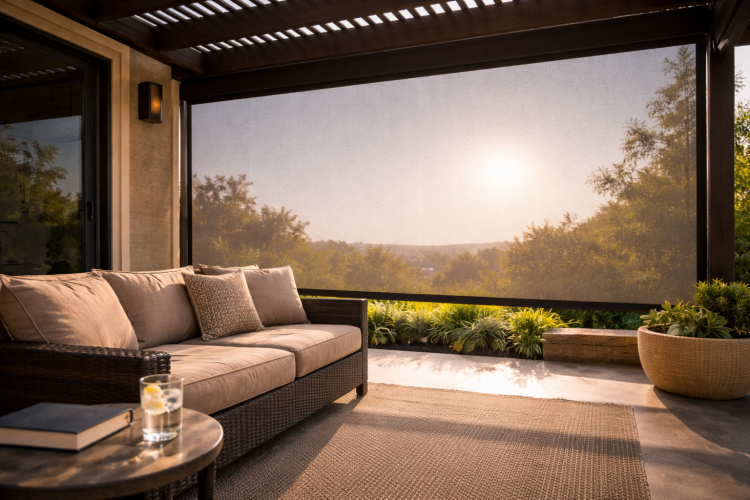
The good news is that most quality outdoor shade systems give you options. Motorized screens, for example, can be ordered in varying levels of openness, from high-visibility mesh that filters light while keeping your view to denser fabrics that provide strong privacy. The key is knowing what you need before you order.
How to evaluate your privacy needs:
Stand on your patio and look at the sightlines from neighboring properties, the street, and any elevated areas nearby. Then think about what time of day you use the space most. If you’re a morning coffee person, morning sightlines matter more. If you entertain in the evenings, you need to think about lighting and privacy after dark. A good installer will walk you through these considerations before recommending a product.
The Bottom Line
Choosing outdoor shades for your patio is not complicated, but it does require more thought than most people give it. The homeowners who end up frustrated are almost always the ones who skipped one of these steps, bought on price, ignored the wind, forgot about privacy, guessed at the sun angle, or tried to install a complex system themselves.
When you get it right, a quality outdoor shade system genuinely changes how much you use your outdoor space. You stop avoiding the patio on hot afternoons. You start entertaining outside more. You use the space in the morning without squinting into the sun. That’s a real return on the investment.
If you’re in the Columbus, Dayton, or Dublin, Ohio area and want to get this right the first time, explore our retractable awnings and motorized screens services to see what works best for your patio, or call us at (614) 916-8513 to talk through your options with someone who can give you a straight answer and a free estimate.

Leave a Reply